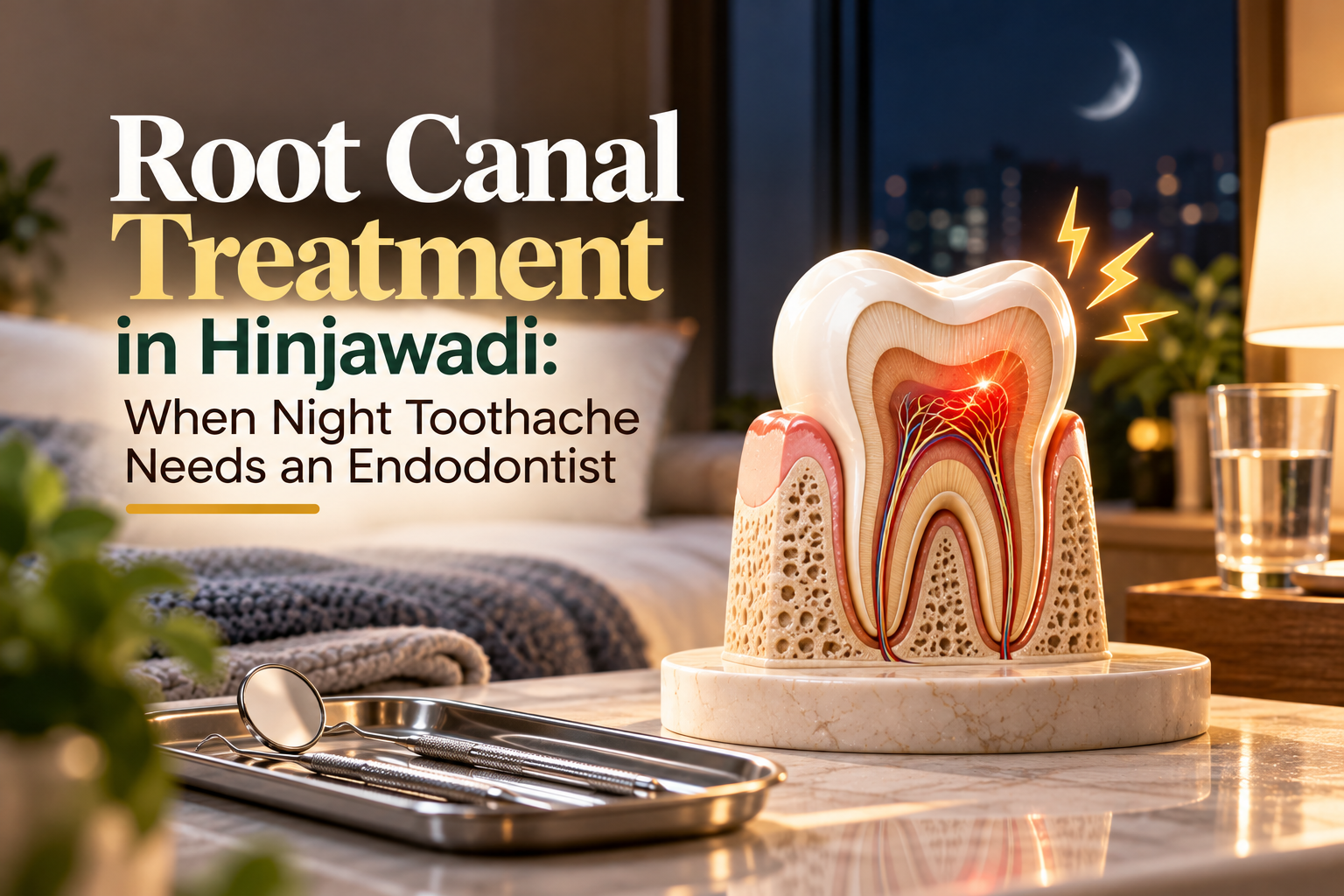
The day was fine. Then you shut the laptop, lie down, and your tooth starts to throb. You shift pillows, press your cheek, check the clock. Sleep is out of the question.
Night-time toothache is one of the most common reasons people call a dentist in a hurry. It rarely settles on its own, and the longer you wait, the harder it gets to fix.
At EternaDent Family Dental Care in Hinjawadi, Dr. Aditya Ingle is an MDS endodontist. That means his specialist training is in the inside of the tooth: the nerve, the roots and saving teeth that are badly infected. Here is why night pain happens and when a root canal is the right answer.
Why toothache gets worse at night
It is not your imagination.
- More blood flows to your head when you lie down. An inflamed tooth nerve is already under pressure, and extra blood makes it throb harder
- No distractions. During the workday, meetings and deadlines pull your attention away. At night, there is nothing else to notice
- Clenching and grinding. Many people grind their teeth in sleep, which adds force to a sore tooth
- Less daytime relief. Sipping water and moving around can ease discomfort for a while
The tooth is not worse because of the hour. The problem was already there. Night just shows it up.
Common causes of severe toothache
- Deep cavity. Decay has reached close to the nerve
- Inflamed or infected nerve. Often called pulpitis. The classic cause of throbbing night pain
- Tooth abscess. A pocket of infection at the root, often with swelling
- Cracked tooth. Pain on biting, or with hot and cold
- Failing old filling. Bacteria get in under it
- Gum infection. Pain, swelling and a bad taste around one tooth
- Wisdom tooth trouble. A partly erupted tooth can get infected
- Sinus problems. Upper back teeth can ache when the sinuses are blocked
Only an exam and an X-ray can tell these apart. Guessing is how people lose days, and sometimes teeth.
Signs you may need a root canal
Pain alone does not mean you need one. But these signs make it more likely:
- Throbbing pain that wakes you up or stops you from sleeping
- Pain that lingers for minutes after hot or cold
- Pain when you bite or press on the tooth
- Swelling in the gum or face
- A small pimple-like bump on the gum near the tooth
- A tooth that has turned darker than its neighbours
- A bad taste or bad breath from one area
- A deep cavity or large old filling in that tooth
If you have two or more of these, please see a dentist soon.
What is a root canal, in simple words?
Inside every tooth is a soft tissue called pulp. It holds the nerve and blood vessels. When deep decay or a crack lets bacteria in, the pulp gets infected.
A root canal treatment removes the infected pulp, cleans the inside of the tooth and seals it. The tooth is then protected, usually with a crown, and stays in your mouth.
The other option is pulling the tooth out. In most cases, your own tooth is the best option you have.
Why see an endodontist for a root canal?
Any trained dentist can do a root canal. But an endodontist does little else.
- Focused training. Endodontics is a specialty in saving teeth from the inside. Dr. Ingle holds an MDS in this field
- Complex cases. Some teeth have curved, narrow or extra canals that are hard to clean. This is where specialist training helps
- Retreatment. If an earlier root canal failed or the pain came back, an endodontist is the right person to look at it
- Careful diagnosis. Knowing whether a tooth needs a root canal, a filling or nothing yet is half of the job
If your general dentist has suggested a root canal, or you are not sure about one, a second opinion is perfectly reasonable.
Is a root canal painful?
This is the number one fear, so here is the honest answer.
The infection hurts. The treatment does not have to.
- We use local anaesthesia, so the tooth and the area around it are numb
- Most patients feel pressure, not pain
- Mild soreness for a day or two afterwards is normal and can be managed
- Most patients say the pain they had before treatment was far worse
If you have had a bad experience in the past, tell us. We will go at your pace.
Root canal treatment in Hinjawadi: what happens at EternaDent
1. Examination and X-ray
Dr. Ingle examines the tooth and takes an X-ray to see how deep the problem goes and how many roots the tooth has.
2. Explanation
You get a clear explanation of what is wrong, whether a root canal is needed and what the plan looks like. If a simpler treatment works, we say so.
3. Numbing
The tooth is made fully numb before we start.
4. Cleaning the canals
We open the tooth, remove the infected pulp and clean the canals thoroughly.
5. Filling and sealing
The cleaned canals are filled and sealed so bacteria cannot return.
6. Crown
A root canal tooth is weaker than a healthy one. A crown restores its shape and protects it from cracking.
Some teeth can be finished in one visit. Others need two or more, especially if there is an active infection. We will tell you what to expect for your tooth.
If you are searching for root canal treatment in Hinjawadi, Pune, we suggest you come in as soon as the pain starts. Early treatment is simpler, shorter and easier on your wallet.
What does a root canal cost?
Many people delay treatment because of the RCT cost. It is a fair worry, so here is a straight answer.
The cost depends on:
- Which tooth it is. Back teeth have more roots and take longer
- How severe the infection is
- Whether you need a crown afterwards
- How many visits are required
We give you a clear estimate after the examination and before treatment begins.
Waiting rarely lowers the bill. A tooth left alone can develop an abscess and spread infection, and may eventually need extraction and replacement, which costs more than a root canal and crown.
What to do tonight while you wait for your appointment
This is first aid only. It does not fix the cause.
- Rinse gently with lukewarm water
- Floss around the tooth to remove any stuck food
- Keep your head slightly raised with an extra pillow
- Avoid very hot, cold, sweet or hard food on that side
- Do not put aspirin or any pain tablet directly on the gum. It can burn the tissue
- If you take pain relief, follow the label or your doctor’s advice
- Do not press or poke at a swollen area
When it is an emergency
Come in the same day, or go to a hospital, if you have:
- Swelling in your face, jaw or neck
- Fever along with a toothache
- Difficulty swallowing or breathing
- Swelling that is spreading quickly
- Pain that no medicine can touch
These can be signs of a spreading infection. Do not wait until morning.
After a root canal: aftercare
- Mild soreness for a few days is normal
- Avoid chewing hard food on that side until your crown is in place
- Brush and floss as usual
- Finish any medicines prescribed
- Come back for your crown. Skipping it is the most common reason root canal teeth fail
- Call us if swelling, fever or strong pain appears
Frequently asked questions
How do I know if I need a root canal or just a filling?
If decay is small and the nerve is healthy, a filling is enough. Night pain, lingering pain to hot and cold, or swelling points towards a root canal. An X-ray confirms it.
Can a toothache go away on its own?
The pain may pass if the nerve dies, but the infection stays and can spread. A tooth that suddenly stops hurting is not necessarily healed.
Is a root canal painful?
It is done under local anaesthesia, so you should not feel pain during the procedure. Some soreness afterwards is normal.
How long does a root canal take?
Anywhere from one to a few visits, depending on the tooth and the infection.
Do I need a crown after a root canal?
Usually yes, especially for back teeth. The crown protects a weakened tooth from breaking.
My root canal tooth hurts again. What now?
Sometimes a treated tooth gets reinfected. It can often be treated again. See an endodontist for an assessment.
What is the alternative to a root canal?
Extraction. But a natural tooth is almost always better kept, and replacing a missing tooth takes more time and cost.
Is there an endodontist near me in Hinjawadi (Hinjewadi)?
Yes. Dr. Aditya Ingle, MDS endodontist, practises at EternaDent Family Dental Care, Shop no. 2002, Streets of Europe, Maan Road, Phase 1, Hinjawadi, Pune 411057.
Book your visit
Please do not spend another night in pain. A toothache that wakes you up is a signal to act. The sooner we see it, the easier the treatment.
Clinic hours: Monday to Saturday 10am to 8pm, Sunday 10am to 2pm.
Call or WhatsApp EternaDent Family Dental Care on 088308 18952 to book root canal treatment in Hinjawadi, Pune.
Clinic address: Shop no. 2002, Streets of Europe, Maan Rd, Phase 1, Rajiv Gandhi Infotech Park, Hinjawadi, Maharashtra 411057